
Author: Igor

  • Cat Lifespan: How Long Do Cats Live & Factors Affecting It

    If only cats can live forever, many pet owners would be on cloud nine. However, every living thing has its limits, including felines. And no, cats do not necessarily only have nine lives. 

    A cat’s lifespan depends on the home and veterinary care they receive. There are also other factors that influence how long they live. Some cats even live beyond their average lifespan. 

    Generally, cats can live up to 12 to 15 years. However, there’s a difference between indoor and outdoor cats. Indoor cats can sometimes live for 20 years or more. Outdoor cats, on the other hand, typically live for shorter years due to many factors.

    As cat owners, it’s vital to know how to care for your feline companions so that you can give them long, happy lives.

    A proud cat owner holds his adult feline companion who enjoys staying indoors, away from dangerous elements that reduces cats’ lifespans.

    Factors That Affect a Cat’s Lifespan

    Various factors can affect how long a cat lives. Some of these are natural causes that most vets and pet owners have no control over. But, other factors can be managed with proper care.

    • Genetics

    Certain cat breeds have naturally longer lifespans than others. Some cats may have hereditary health problems that can shorten their lifespans. Mixed-breed cats might have longer lifespans because they have fewer genetic disorders.

    • Diet and Nutrition

    Cats that have poor diets are prone to obesity, diabetes, and other metabolic issues that can reduce their lifespan. Those that eat well-balanced diets with essential nutrients live longer lives.

    • Veterinary Care

    Routine health checks can help detect diseases early before they become worse. Vaccinations, parasite management, and dental health care also play a big role in prolonging your cat’s health. 

    • Cat Neutering

    This is not mandatory for cats. But when cats undergo this surgical procedure, it eliminates the risk of reproductive cancers and infections in cats. Neutered felines will have lesser chances of roaming outdoors.

    • Environment

    Outdoor cats have shorter lifespans because they are more exposed to harsh elements outside their homes. These may include traffic, fights with other animals, harsh weather, and parasites.

    An online survey collected data from 5,000 Central European cat owners. The results found that over 70% of cats involved in traffic accidents died. This shows how dangerous roaming behavior can be for feline pets.

    • Physical & Mental Activities

    Regular exercise helps maintain their weight and health. Mental stimulation also contributes to preventing stress-related illnesses and cognitive decline. Cats that didn’t receive enough mental and physical exercises during the first stages of their lives, might experience more health issues later on.

    By understanding and managing these factors, any cat owner will be equipped to help their cats live longer, healthier, and happier lives.

    Life Stages of a Cat and Their Needs
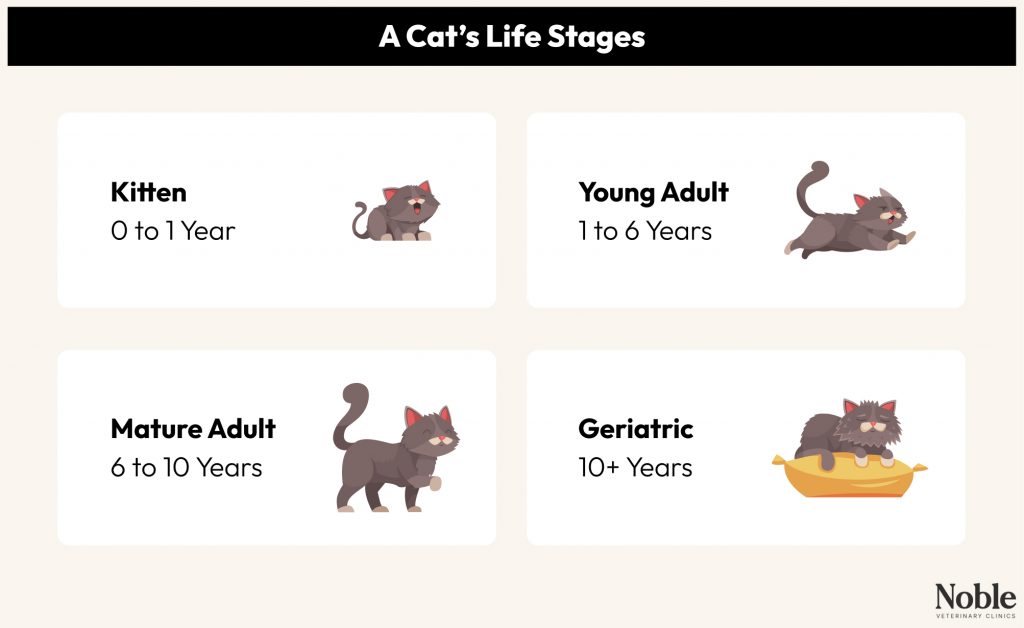
    Cats have several life stages, and their needs change during each phase. Here’s an outline of what to expect and how to care for a cat in each life stage.

    1. Kitten (Birth to 12 Months)

    The kitten stage is an important phase in a cat’s life. This is when they require proper care and nutrition for a healthy growth. Their immune systems are also developing, which makes them susceptible to various illnesses.

    Their high energy and curiosity add to the challenging aspect of caring for them. During this stage, socialization and playtime are highly essential to help them be comfortable and friendly with humans and other pets. 

    Kittens require a specific diet that will promote proper growth. During the first weeks of their life, they’ll also need essential cat vaccinations. These will protect them from preventable diseases like rabies, feline distemper, and calicivirus. 

    Some cat owners also neuter their pets during the first year to prevent health issues and behavioral issues like marking and spraying.

    2. Young Adult (1 to 6 Years)

    When a cat becomes a year old, they reach physical maturity. They’ll have a lower calorie requirement. However, they are also more prone to obesity, so weight management must be followed.

    Young adult cats may also be susceptible to common health issues like asthma and urinary tract infections. This is why veterinarians recommend yearly routine checkups to monitor their health. 

    3. Mature Adult (6 to 10 Years)

    As cats mature further, their activity levels become reduced, and they become more inclined to gain excessive weight. They may show early symptoms of kidney disease, arthritis, and digestive problems.

    Some of the symptoms that a mature adult cat may be experiencing health issues include avoiding the litter box, frequent potty accidents, excessive vocalization at night, and restlessness.

    The vet may recommend bloodwork to be done yearly to monitor their thyroid, liver, a nd kidney health. Dental care will also need to be highly prioritized at this point.

    4. Geriatric (10+ Years)

    The senior life stage of cats is when they become vulnerable to many health issues. Just like elderly humans, a senior cat’s health may decline, and its immune systems may be compromised. 

    Instead of an annual vet visit, your veterinarian may recommend routine health assessments every six months. This is to monitor their blood pressure and for any signs of chronic diseases.

    You may want to adjust their living environment to help them live more comfortably. There are orthopedic pet beds and easy-access litter boxes available for senior cats.

    Conclusion

    Cats may not live as long as humans, so they deserve the best care to help them live a quality life. There are three things that can help prolong a cat’s lifespan: veterinary care, a healthy diet, and good hygiene.

    When it comes to letting cats roam outside, pet owners worldwide are divided. Some believe that there’s nothing wrong with letting their cats enjoy the outdoors. However, keep in mind that outdoor cats are more exposed to dangerous risks.

    The important thing is to keep your cat healthy and happy while preventing dangers and health issues as much as possible. 

    FAQs

    1. How long do cats live?

    The average cat lifespan is 12 to 15 years, but some cats reach over 20 years old with proper care and medical intervention. 

    2. What is the average lifespan of a domestic cat?

    Domestic cats that strictly stay indoors can live up to 18 years. Cats that roam outdoors are exposed to dangerous risks that give them an average lifespan of 2 to 7 years.

    3. How long do female cats live?

    Female cats may have a slightly longer lifespan than males that exhibit roaming behavior. Spayed females can have higher lifespans because reproductive health conditions are completed eliminated.

    4. What is the longest cat lifespan ever recorded?

    The oldest cat that on record is Creme Puff who lived until 38 years old. She was a mixed tabby cat from Texas.


  • What Should A Business Never Be?

    In life, in order to play any game, it’s important to learn rules and how to play. This is often proactive, about what to do and when. But it’s also just as important to learn what not to do. For example, if you land on the jail section of your monopoly board, in order for the game to continue, you cannot ignore it and must spend several turns in jail.

    When running a business, then, it’s essential to to know what not to do as opposed to what to do. After all, anyone can put together a strong business vision or have a thousand great ideas to launch a business with, but learning the strict parameters that give your business backbone is essential. It can also help you avoid issues which are unacceptable to experience, such as putting individuals at risk, mistreating staff by implication, or struggling to consider your social responsibility.

    In this post, we’re going to discuss what a business should never be, so you know which pitfalls to avoid:

    Image via Pexels

    Incapable Of Safety Management & Audits

    Safety management matters more than most newer businesses realize, because ultimately this really is a life or death matter. You must never allow anyone to suffer because of a failed system, and while a 0% incident rate is unfortunately a tough ask, it’s one you must consistently shoot for as the only acceptable outcome. 

    You can of course, avoid being a company more likely to suffer this, such as those that skip regular safety audits, which are basically playing with fire. Safety checks need to be normal routine, and not something hastily done after someone gets hurt. The whole safety mindset needs to flow through the company, which means from the boss’s decisions down to everyday work.

    That means making it easy for workers to report problems and fix them quickly. You should actually train your staff properly and refresh that training often. Also have reporting systems in place, because this way a staff member can signify the need for commercial railing replacement if the old installation is loose or unstable. As you can see, communication is essential.

    Unclear With Hiring Responsibilities

    Believe it or not, some businesses hire people and sort of let them stay in place as opposed to providing a clear set of parameters for what they need to do. That’s especially true for businesses that may be newer and less experienced. But all staff need to know exactly what they’re supposed to do and what isn’t their job. Without clear responsibilities they’ll become generalists and overlap, perhaps even step over one another, and essential duties can easily through the cracks while other tasks get done twice.

    You need to make it certain who makes which decisions, who reports to whom, and how success gets measured. Without this clarity, nobody can be properly accountable and you may even have staff who rarely achieve anything, or even just attend the job and barely do anything. This has happened in many firms. Moreover, employees get frustrated when they can’t see how their work matters, and managers struggle to give useful feedback to guide them. It’s a rot that could simply be avoided by carefully delineating what to do and when.

    Unaware Of Vital Compliance

    Businesses must operate within vital compliance rules to even get off the ground, but if you fail to properly match your inspections and adhere to essential guidelines, then you can be shut down easily. It’s not fun, sure, but it requires your attention and correct paperwork. You have to stay up to date on legal requirements that affect how you operate and what you sell.

    This can look different in different companies of course, but the overall assertion is this – to focus on the fundamental rules of your industry, to have legal inspectors and careful consideration when it comes to expanding into new fields. This is one of those areas where you simply cannot feign ignorance, you have to operate within the legal parameters, or you don’t operate. Your business will no doubt have no issues here, but you’d be surprised just how many do.

    Unable To Vet Staff & Suppliers

    A business that can’t properly check the background of new hires or suppliers is ultimately going to get bitten, especially if the deal feels too good to be true. It’s true that trust matters, but verification matters more. Companies need solid processes to screen potential team members, and that might mean basic reference checks to more detailed background screening for sensitive positions that handle important information.

    The same goes for suppliers and vendors too, as we alluded to. Companies that blindly accept new business relationships risk their reputation, security, and legal standing, and believe us when we say customers are much more focused on unearthing these connections as they care more about being conscious with their purchasing power. You should develop reasonable standards for vetting partners and stick to those standards even when rushed or pressured.

    Failing To Integrate Strong Accounting & Bookkeeping Systems

    Outside of safety, there’s arguably nothing worse for your business than starting out life with improperly manage books. These issues can grow and before you know it, you’re experiencing a full tax audit that could lead to huge fines or even criminal time. If you fail to put a method in place or use an accountant to help you do that, companies lose track of what they owe, what they’re owed, and how money flows through the organization. 

    That’s why keeping up clean records that provide genuine insight into company performance, not just numbers for tax purposes, will be essential. Then your financial reviews happen proactively, not just when problems come and you need to dig through the history.

    With this advice, you’re certain to rn a businuess with care and clarity, with as much of a mind for what you shouldn’t do as well as all the proactive business advice you can find. That way, you may find a better push-pull dynamic through your business decision making.

  • Hidden Heroes in Your Home: How Tiny Tech Keeps Life Smooth and Safe

    The Overlooked Tech That Powers Everyday Life

    Every home depends on small, often unnoticed devices to keep everything running smoothly. These gadgets may not grab the spotlight but are critical to modern living.

    Take your Wi-Fi router, for example. It works tirelessly in the background, connecting your devices and enabling your smart gadgets to function seamlessly. Then, there are smart thermostats, which adjust temperatures automatically to save energy without you giving it a second thought.

    These quiet performers prove that even the smallest technologies can significantly impact. They demonstrate how much we’ve come to rely on innovations we barely notice.

    When Convenience Meets Safety

    Modern homes are designed for convenience, often relying on integrated safety measures to protect families. Consider the importance of smoke detectors—they continuously monitor the air, ready to alert you to danger. Similarly, smart locks allow you to secure your home with just a tap on your phone.

    Another example is automated leak detectors. These devices track water flow and catch signs of leaks early, protecting your home from costly damage.

    Of course, no conversation about safety would be complete without tackling electrical risks. Even something as simple as upgrading your circuit breakers can stop small issues from sparking major hazards. This often-overlooked technology works quietly to prevent electrical overloads and keep your home safe.

    The Secret Life of Smart Home Hubs

    Smart home hubs, such as Amazon Echo or Google Home, act as the brain of your connected home. These devices ensure smaller gadgets—like smart plugs or light bulbs—work in perfect harmony.

    When you tell a smart speaker to turn on the lights, it sends that command to the corresponding devices. These hubs also coordinate schedules, from coffee makers starting in the morning to thermostats lowering energy use when you’re away.

    This behind-the-scenes coordination keeps daily routines effortless and consistent.

    Behind the Scenes: Sensors You Never Notice

    Some of the hardest-working technologies in your home are entirely invisible. Motion sensors detect movement to trigger alarms or turn on outdoor lights. Temperature monitors ensure your heating and cooling stay at the right levels.

    Air quality detectors also play a vital role. By analyzing particles in the air, they warn you of pollutants or allergens before they cause harm.

    These silent sensors not only provide data to other systems but also enhance your comfort and safety—without any extra effort on your part.

    How Tech Stops Problems Before They Start

    One of the most important advances in modern technology is its ability to predict and prevent issues. Devices like smart refrigerators can alert you if food is about to spoil, while software updates for connected gadgets often include fixes to address potential security risks.

    Predictive maintenance is also a game-changer. Automated systems can run self-checks to identify small problems before they grow. These innovations mean fewer disruptive repairs and more peace of mind.

    Smarter Living Without Lifting a Finger

    Today’s homes are designed to work behind the scenes. Automation handles everything from lighting to security, creating a lifestyle of ease and reliability.

    Gone are the days of manual adjustments or constant monitoring. Instead, integrated systems ensure smooth operations while giving you more time to focus on what matters most.

    Whether it’s smart hubs, sensors, or preventative devices, technology makes modern living simpler, safer, and stress-free.

    Small Gadgets, Big Impact on Everyday Living

    The unsung heroes of modern life are often the ones we rarely notice. From safety features like upgraded circuit breakers to the convenience of automated systems, tiny tech plays a crucial role in shaping how we live.

    Take a moment to consider the tech nestled in your own home. By identifying these invisible helpers, you might find ways to further improve safety, energy efficiency, and overall comfort. Appreciating these small innovations can go a long way in making your life smoother—and your home smarter.

  • How BIM Modeling Enhances Project Collaboration and Efficiency

    In today’s construction market, cooperation and efficiency are the keys to delivering successful projects. The complicated nature of architectural, engineering, and construction (AEC) projects requires advanced tools to streamline processes, eliminate errors, and increase coordination between different participants. The most effective methods are available within Building Information Modeling (BIM), a method of technology that has transformed the manner in which we work. Through the integration of digital models into real-time information, BIM modeling can improve the efficiency of communication, decrease cost, and speed up the timeframes of the projects. From the initial Designing and Drafting to the construction phase, BIM is a key factor in creating a smooth collaboration.

    Image via Unsplash

    Enhancing Communication and Coordination

    BIM modeling enhances communication between engineers and architects, as well as customers and others, through the use of a central electronic technology. In contrast to traditional 2D drawings that can be difficult to comprehend, BIM models offer a 3D representation of the concept. This clarity of the visuals allows teams to spot potential areas of conflict at the beginning of design and prevent costly changes later on.

    In addition, BIM enables real-time collaboration because it permits multiple stakeholders to work together on a similar design. Cloud-based BIM platforms offer quick updates to ensure that everyone gets access to every detail about the project. This helps to reduce the risk of discrepancies or miscommunication among teams.

    So, architects may alter their designs, and structural engineers can be in a position to evaluate how these modifications impact the load distribution. Additionally, engineers in electrical and mechanical engineering are in a position to coordinate the design of the systems so that there is no conflict. The synchronization procedure significantly improves the effectiveness of projects and reduces the amount of time entailed by errors and the necessity of reworking.

    Improved Project Planning and Visualization

    One of the biggest advantages of BIM modeling is the capacity to enhance the process of planning projects. By using 4D BIM, the groups can incorporate data associated with time into their model. This permits accurate scheduling and sequencing of work. Project managers are able to identify any potential bottlenecks, improve the distribution of resources, and track the timeframes for projects.

    Additionally, 5D BIM integrates cost estimation for those who are involved in designing a comprehensive understanding of the budget-related implications. Through the simulation of different design scenarios, the team members can evaluate costs and come to an informed decision that balances accessibility and high quality.

    Visualization is another element in which BIM excels. Customers and others involved can examine the design before the construction process even starts and gain precise knowledge of what the final product will be. This helps decrease uncertainty and boosts the process of making decisions, leading to a higher level of satisfaction among clients.

    Increased Efficiency and Reduced Errors

    Traditional construction methods typically require multiple revisions due to design issues or other unknown issues. BIM modeling helps solve these problems by creating an efficient and accurate model that integrates every element of the design. Tools for discovering clashes can detect conflicts with structural, mechanical, and electrical components, allowing teams to resolve issues before construction even begins.

    If the plumbing system is at odds with the structural design, BIM software will alert the building team of potentially costly modifications. This proactive approach improves the effectiveness of construction, cuts down on the amount of waste, and ensures the efficiency of building.

    In addition, BIM supports prefabrication and modular construction with the help of accurate models that businesses can utilize for fabrication on-site. It reduces the requirement for labor on site as well as speeds up construction. It also improves the quality of production. Additionally, it enhances the safety of employees by removing labor-intensive jobs that can pose dangers within the environment.

    Facilitating Sustainable Design

    Sustainability is one of the major issues in the construction field, and BIM modeling has a vital role in promoting eco-friendly strategies. By analyzing and quantifying energy consumption, BIM assists teams in optimizing building performance by considering aspects like lighting usage, the ventilation system, and utilization to use energy.

    It is a model that provides a variety of methods for construction and building materials; teams can choose environmentally friendly options that will reduce ecological impact. Furthermore, BIM facilitates lifecycle analysis and aids stakeholders in understanding the long-term maintenance and operating costs.

    Regulators and authorities often have to ensure that sustainability standards are met. BIM is a good way to ensure compliance with sustainability standards. BIM assists in achieving this goal through the incorporation of data on environmental performance into the development of plans. It not only ensures compliance with the regulations; however, it can also increase the effectiveness overall and endurance of the built environments.

    Streamlining Construction and Cost Estimation

    While construction is underway, BIM continues to enhance efficiency through enhanced coordination and logistics. Contractors are capable of using BIM models to design detailed construction schedules, track the progress of their projects, and optimize workflow. The integration of drones and AR (AR) and robotics in BIM increases the precision of BIM and minimizes mistakes that are made manually.

    Building information modeling could also contribute to estimates of cost and budgeting. With BIM Modeling Services, contractors and estimators can obtain precise quantities taken off and decrease the risk of budget-related excesses. Contrary to traditional methods of estimation that depend on spreadsheets and hand calculation, BIM provides automated cost estimation based on the real-time data of projects.

    Furthermore, BIM supports risk management by enabling teams to assess potential risks to the project and develop ways to reduce them. By anticipating problems and solving these issues, contractors are able to enhance safety, decrease the chance of accidents, and increase the overall success and efficiency of their projects.

    Better Facility Management and Post-Construction Benefits

    The benefits of BIM extend beyond the conclusion of a construction project. Facilities managers, as well as owners, have the choice to use BIM models to manage operations and maintenance. Through the precise asset information embedded in the model, maintenance staff will be able to locate the building’s components and keep track of the condition of equipment as well as design and construction renovations efficiently.

    In the event, for example, that heating systems need to be repaired, facility administrators have access to the BIM model to find the relevant data, which will cut down on the amount of time needed to repair as well as the cost of maintenance. The data-driven technique helps in improving asset management, improves the efficiency of buildings, and increases the life span of buildings.

    Additionally, BIM aids in disaster management by offering precise building records. When emergencies occur, such as fires or structural problems, emergency responders can employ BIM plans to move buildings in a controlled and effective manner. Utilizing Framing Estimating Services, contractors are able to get a precise estimate of materials, thereby decreasing waste materials and maximizing effectiveness.

    Conclusion

    Building information modeling has revolutionized the construction industry through increased collaboration, improved efficiency, and reduced expenses. Its capability to incorporate planning, design, and cost estimation into the same platform provides smooth communication and better project performance. From the beginning of the concept to managing infrastructure, BIM plays a vital role in streamlining workflows as well as increasing the efficiency of resource use.

    While technology continues to evolve, BIM will remain a vital element in construction in the future and is driving advancements and sustainable growth within the field of construction. Incorporating BIM isn’t just a matter of choice; it’s a necessity for AEC professionals looking to stay at the forefront of the ever-changing world of business.

  • 7 Game-Changing Strategies to Improve Your Ad Campaigns

    If your ad campaigns aren’t delivering the results you expected, you’re not alone. Many businesses invest in advertising but struggle to see a return on investment. The good news? Small adjustments can make a huge difference. Whether you’re trying to lower costs, increase engagement, or get more conversions, refining your approach can turn an underperforming campaign into a highly effective one.

    Here are seven key strategies to take your ad campaigns to the next level.

    1. Use a Self-Service Platform for More Control

    If you’re still relying on third-party agencies or outdated systems to manage your ads, you might be missing out on flexibility and cost savings. Self-service ad platforms give you direct control over your campaigns, allowing you to:

    • Set and adjust budgets in real-time
    • Target specific audiences with precision
    • Optimize campaigns without waiting for external approvals

    With real-time analytics and control over bidding strategies, SSP marketing allows businesses of all sizes to refine their approach without needing a dedicated ad manager. If you’re serious about improving your campaigns, making the switch to a self-service platform is a smart first step.

    2. Master Your Audience Targeting

    Throwing money at ads without a well-defined audience is a fast way to burn through your budget. Instead, fine-tune your targeting by focusing on:

    • Demographics – Age, gender, income level, and other factors
    • Interests and behaviors – What are your potential customers searching for? What other brands do they engage with?
    • Retargeting – Serving ads to people who have already interacted with your business

    Most platforms offer incredibly detailed targeting options. Use them to your advantage by testing different audience segments and adjusting based on performance. The better your targeting, the less wasted spend on people who will never convert.

    3. Craft Headlines That Stop the Scroll

    No matter how good your product is, if your ad doesn’t grab attention instantly, people will keep scrolling. Your headline is the first thing they see—make it count.

    A great ad headline should:

    • Speak directly to a pain point or desire
    • Be clear and concise (avoid fluff)
    • Create curiosity or urgency

    Compare these two headlines:

    ❌ “We Have the Best Deals on Shoes”
    ✅ “50% Off Sneakers—Today Only!”

    The second one is specific, urgent, and likely to drive action. Test multiple variations of your headlines to see which ones resonate best with your audience.

    4. Make Your Creative Stand Out

    A dull or generic ad will be ignored, no matter how well-targeted it is. Your visuals and messaging need to be compelling enough to stop people from scrolling past. High-quality images and videos are essential—low-resolution, poorly lit visuals won’t grab attention. But it’s not just about quality; your ad creative should also match the platform you’re using. An image that works well for Facebook might not perform the same way on TikTok or LinkedIn.

    Keeping things simple is another key factor. Overly cluttered designs or too much text can confuse viewers and dilute your message. A strong visual paired with a clear, concise message works far better than something overloaded with information. Short-form video content is also performing better than ever across various platforms, so if you haven’t experimented with video ads yet, now is the time to test them out.

    5. A/B Test Everything

    No matter how much experience you have, guessing what works is a dangerous game. A/B testing removes the guesswork by letting you compare two versions of an ad to see which performs better.

    Things you should regularly test:

    • Headlines and ad copy
    • Images vs. videos
    • Call-to-action (CTA) buttons
    • Audience segments

    Even small tweaks—like changing the background color of an ad—can lead to noticeable improvements. Always let data guide your decisions.

    6. Optimize for Mobile

    More than half of online traffic now comes from mobile devices, yet many ads are still designed with desktop users in mind. If your ads aren’t optimized for mobile, you’re likely losing out on a huge portion of your audience. Ensuring your ad formats align with mobile platforms is critical—square or vertical formats generally perform better on social media, while overly small fonts or cluttered designs can make ads unreadable on smaller screens.

    Speed is another crucial factor. If your landing pages take too long to load on mobile, potential customers will leave before they even see your offer. A slow website can single-handedly ruin an otherwise great ad campaign. Mobile optimization isn’t just about making sure your ads look good—it’s about ensuring a seamless, fast experience from the ad click to the final conversion.

    7. Focus on Conversions, Not Just Clicks

    Clicks are great, but they don’t mean much if they don’t lead to sales, sign-ups, or other meaningful actions. Too many advertisers get caught up chasing high click-through rates without focusing on what really matters—conversions.

    How to improve your conversion rates:

    • Use clear and compelling CTAs – Tell users exactly what to do next
    • Streamline the landing page – Remove distractions and unnecessary steps
    • Ensure fast load times – Slow pages kill conversions
    • Leverage social proof – Reviews, testimonials, and trust signals build credibility

    By focusing on conversion rate optimization (CRO), you’ll make sure your ad spend is actually generating results.

    Small Tweaks, Big Impact

    The best ad campaigns aren’t about spending more money—they’re about spending it wisely. By refining your approach with better targeting, stronger creatives, and data-driven optimizations, you’ll get more out of every dollar.

    Even if your campaigns are already performing well, there’s always room for improvement. The key is to keep testing, analyzing, and refining. With these seven strategies, you’ll be on track to creating ads that don’t just get clicks—but real, measurable results.